


Female Genital Mutilation in Benin: 1 in 10 women have undergone excision, and the poorest are most affected. bear the heaviest toll

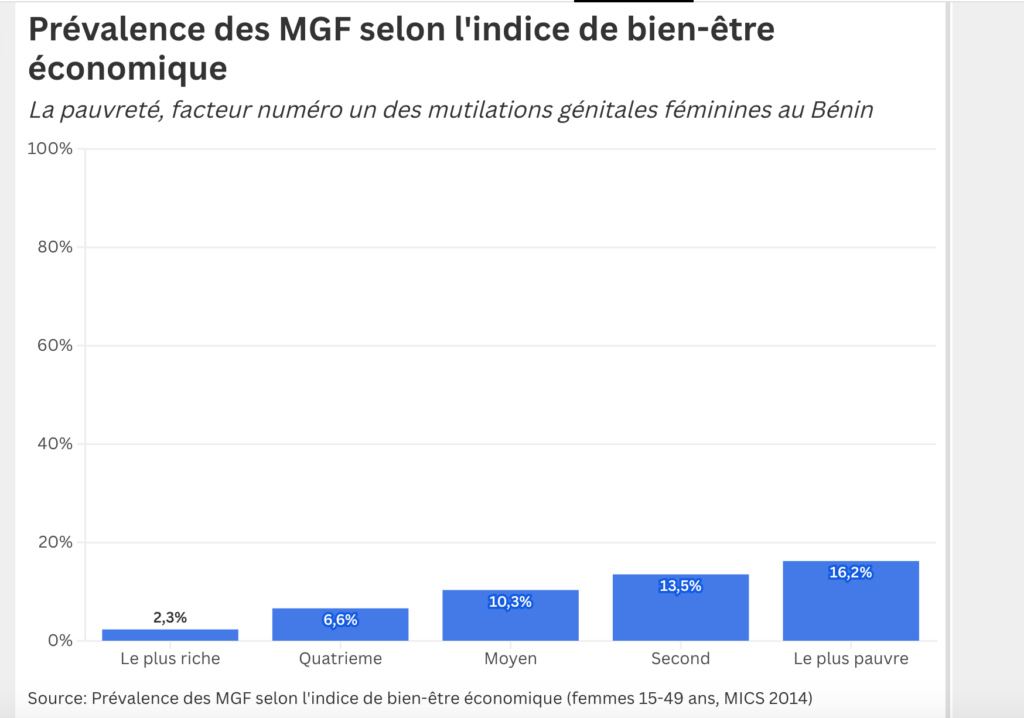
A poor Beninese woman is seven times more likely to have undergone female genital mutilation (FGM) than a rich woman.According to thethe latest national survey to have measured the phenomenon,16.2% of women from the poorest households have undergone female genital mutilation, compared to 2.3% among the wealthiest.A discrepancy that, more than ten years after this investigation, has never been updated.
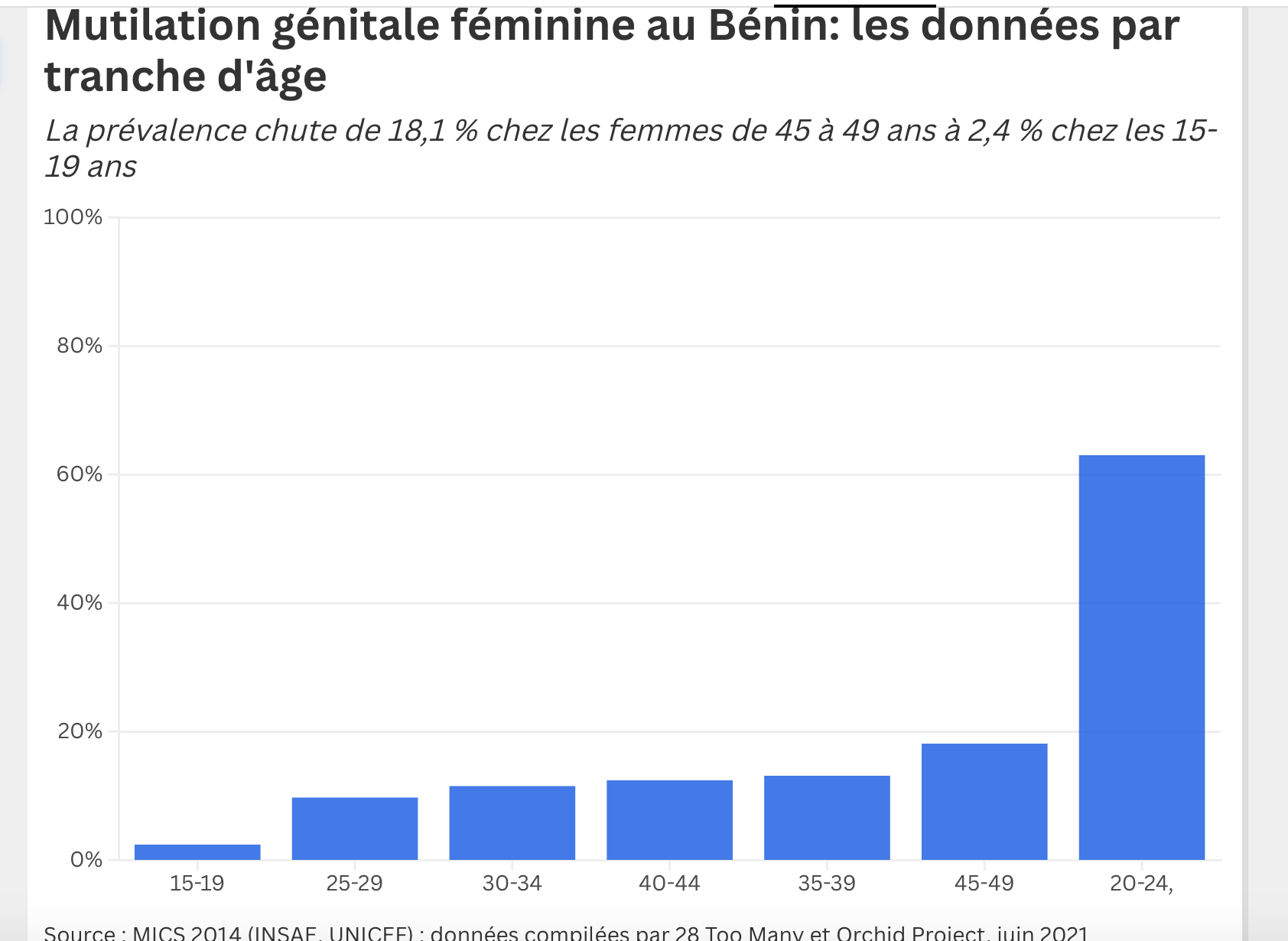
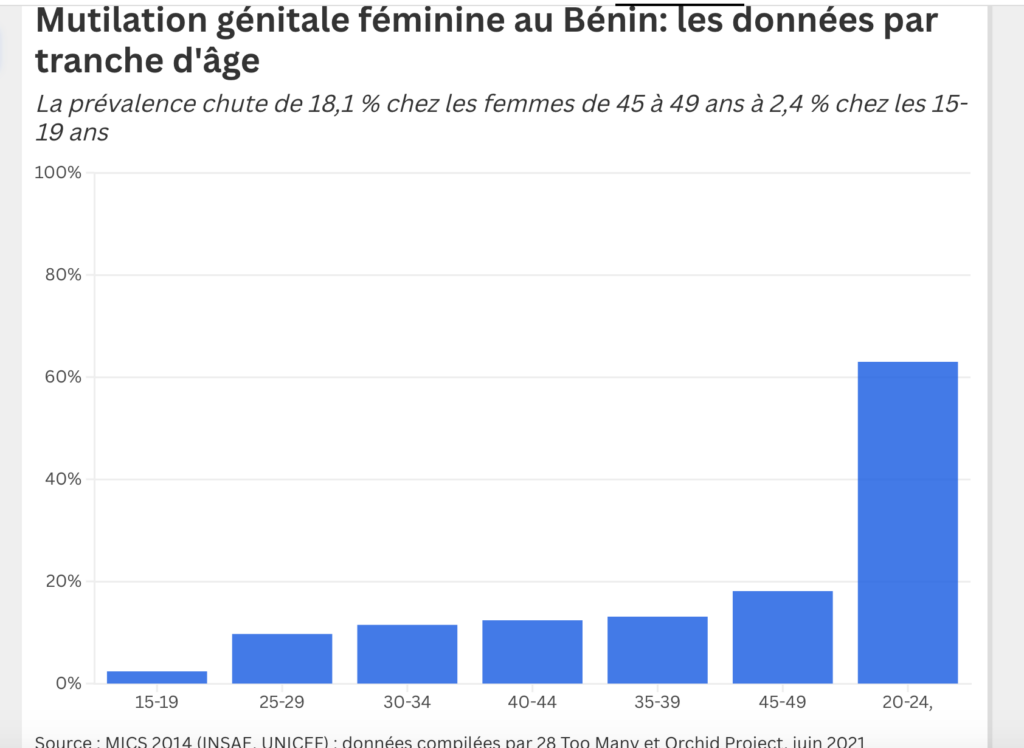
In Benin, nearly one in ten women, or 9.2% to be precise, among women aged 15 to 49, has undergone female genital mutilation, according to theMICS 2014,The last quantitative study that addressed the issue of female genital mutilation (FGM) at the national level was conducted. Following this study, two major national surveys were carried out: the EDSB-V in 2017-2018 and the MICS 2021-2022, published in September 2023. Neither contains data on FGM. (file:///Users/bemerchant/Downloads/Le_dernier_rapport_MICS_pour_le_Be_nin_date_de_2021-2022_.pdf)
<div class=”flourish-embed flourish-chart” data-src=”visualisation/29884198″><script data-src=”https://public.flourish.studio/resources/embed.js”></script><noscript><img src=”https://public.flourish.studio/visualisation/29884198/thumbnail” width=”100%” alt=”chart visualization” /></noscript></div>
In practical terms, Benin has not known for over ten years whether the practice is declining, stagnating, or shifting. The only figures available today come from the Integrated Family, Women and Children Data System (SIDoFFE-NG), which recorded three cases of FGM on minors between January 2024 and April 2025, and no cases on adults.
What the national real-time monitoring says
Between January 1, 2024 and April 30, 2025, the Integrated Family, Women and Child Data System (SIDoFFE-NG) recorded3cases of FGM on children
0Cases of FGM on adults. A case of FGM concerning a woman aged 18 to 34 was also referred to law enforcement agencies during the same period.
Mama Sanni Raouf, director of studies at the Observatory of the Family, Women and Children (OFFE), refuses to accept this figure at face value. He says his system likely only captures a portion of the actual cases, particularly in remote areas, and that some Beninese families are now leaving the country to have their daughters circumcised abroad.The absence of a new national survey is therefore not merely a statistical gap; it prevents us from shedding light on a practice that continues, in an increasingly clandestine form, while surveillance mechanisms turn a blind eye.Source: Telephone interview with CEDOCA, 22/05/2025)
Source
Document: IOC Focus Benin — Female Genital Mutilation (FGM), CEDOCA (Office of the Commissioner General for Refugees and Stateless Persons, Belgium), May 27, 2025
PDF page 11 (numbered “Page 10 of 41” in the document’s internal pagination), section 2.1 “Overall Rate and General Trends”
Poverty, the number one factor
What the 2014 MICS report states, however, is unambiguous. Female genital mutilation (FGM) follows the path of poverty. Among women with no education, the prevalence reaches 15.4%, compared to 0.9% among those with a secondary education or higher. The same pattern is observed among girls aged 0 to 14: 0.5% in the poorest households, 0.2% in the wealthiest. The link becomes even more pronounced when the mother has herself undergone FGM, as the prevalence among her daughter then rises to 0.8%. Poverty alone does not explain the practice, but it systematically accompanies it.
<div class=”flourish-embed flourish-chart” data-src=”visualisation/29884066″><script data-src=”https://public.flourish.studio/resources/embed.js”></script><noscript><img src=”https://public.flourish.studio/visualisation/29884066/thumbnail” width=”100%” alt=”chart visualization” /></noscript></div>
Among women aged 15 to 49, the prevalence reaches 16.2% in the poorest households, compared to only 2.3% in the wealthiest, representing a risk seven times higher. Between these two extremes, the decline is steady and gradual: 13.5% in the second quintile, 10.3% in middle-income households, and then 6.6% in the fourth quintile. This continuous trend, without any interruption or stabilization, confirms that while female genital mutilation is not a problem limited to the poorest households, it nevertheless follows a pattern whereby each decrease in wealth is accompanied by an increased risk for girls and women in the household.
The economic burden doesn’t end with who undergoes the practice; it also shapes its cost. According to a 2017 study by the Ministry of Social Affairs and Microfinance (MASM), the price paid to a circumciser has risen from approximately 200 CFA francs to nearly 50,000 CFA francs per girl. This inflation, far from deterring the practice, has transformed some circumcisers into full-fledged economic actors, which partly explains why retraining programs, supported by microloans, have become a central element of the strategy implemented by the government and NGOs to combat this practice.
The North may be the worst, but the South has its own problems
The prevalence map paints a picture of a country divided in two. In Borgou, 37.6% of women aged 15 to 49 have undergone FGM; in Donga, 36.8%; and in Alibori, 23.7%. Conversely, Couffo shows 0% and Zou 0.2%. This snapshot from 2014 reflects another reality, this one sociological: the Bariba (44%), Fulani (41%), and Yoa (29%) ethnic groups practice excision far more than the Adja (0.2%) or the Fon (0.1%).
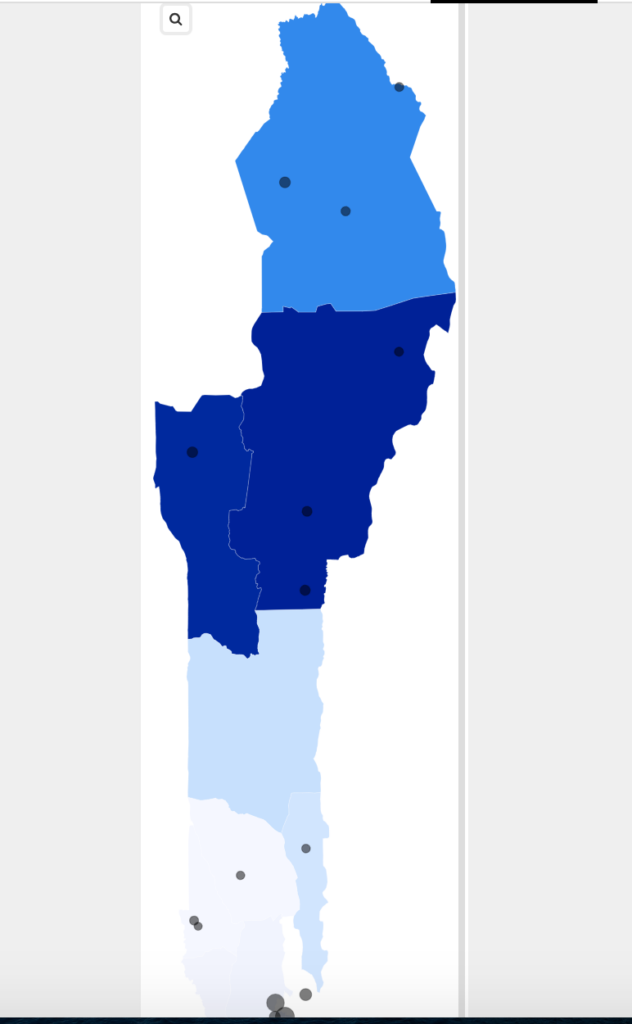
<div class=”flourish-embed flourish-map” data-src=”visualisation/29964405″><script data-src=”https://public.flourish.studio/resources/embed.js”></script><noscript><img src=”https://public.flourish.studio/visualisation/29964405/thumbnail” width=”100%” alt=”map visualization” /></noscript></div>
But a recent report casts doubt on the idea of a completely unaffected South. Alerted by the NGO Nouvelle Afrique, the president of the National Institute for Women (INF), Huguette Bokpè Gnacadja, visited the commune of Lalo, in the Couffo department — a department where the 2014 MICS officially recorded no female genital mutilation.
There, she heard the plea of a group of young girls from the Tchi community, who denounced a practice distinct from traditional female genital mutilation. The repeated stretching of the labia is imposed on them from the age of eleven. In their letter, addressed to the president of the National Institute for the Fight Against Fraud (INF), the prefect of Couffo, and the mayor of Lalo, they expressed their outrage.
“We, the girls of the Tchi community, have decided to break the silence on a practice that deeply affects us: namely, labial stretching. A dangerous and destructive tradition that undermines our dignity and health. […] For too long, labial stretching has been considered normal in the Tchi community, and many of us have suffered and continue to suffer physical and psychological violence in the shadows,” denounced the survivors of female genital mutilation.
The girls detail the concrete consequences of this practice on their schooling;“The repeated pain and early sexual maturity resulting from this harmful practice among us are the root causes of school dropout […] often observed in our community,” they lamented.
While acknowledging that “this practice is often justified by cultural beliefs,” they believe in the intervention of the INF.
“We firmly believe that with your support, labial stretching will be a thing of the past in Tchi territory. We aspire to live in a society where our rights are respected, where our health is protected, and where we can develop our potential without having to suffer from practices that affect us and compromise our future.”
Faced with this plea, the president of the INF confided that she was deeply moved.“I’ve been in shock for three days. I’m really shocked. […] In a community in Lalo, it chilled me to the bone,” she said.
“I listened to a group of young girls who represent the girls of the community and who addressed a plea to the INF. Friends, you have to imagine the physical pain in this constant stretching, and then the psychological trauma. You have to imagine the inflammation it causes, the constant irritation when they walk, the infections that follow, the stigmatization and everything else,” explains Huguette Bokpè Gnacadja.
“We have now reached the point where the wall of silence has been broken.”
Surrounded by representatives of the prefect of Couffo and the mayor of Lalo, who were also present and committed to her side during this meeting, she affirms that she has made a firm commitment on behalf of the institution she heads.“I promised them that we would work until this practice is stopped,” she reassured.
This episode illustrates a flaw in statistical tools. It appears that labial stretching does not correspond to any of the four categories of FGM defined by the World Health Organization (clitoridectomy, excision, infibulation, and other harmful procedures such as piercing or cauterization). It therefore escapes, in effect, the surveys and databases designed to measure excision, including the SIDoFFE-NG database. A department with a 0% rate of excision could still include another harmful practice on girls’ bodies, simply because the data collection criteria are not designed to detect it.
A robust legal framework, a flawed application
On paper, Benin does have a comprehensive legal framework. Law No. 2003-03 was the first to criminalize FGM, with sentences ranging from six months to five years in prison and fines of 100,000 to 3 million CFA francs. The reform of the Penal Code by Law No. 2021-11 went further: Article 524 now provides for up to five years in prison if the victim is a minor, and ten to twenty years’ imprisonment in the event of death. Since 2021, these offenses have fallen under the jurisdiction of the Court for the Repression of Economic Crimes and Terrorism (CRIET).
But a vast gap remains between the law and its application. A search conducted in the Factiva database, covering more than 36,000 media sources in 200 countries, including Benin, for the period from May 2023 to April 2025, found no information on any legal action related to FGM. The 2017 report by the Ministry of Social Affairs and Mediation (MASM) already noted that sentences handed down remain below those stipulated by law, that many prosecutions are dropped, sometimes due to interventions by politicians, and that some convicts are released before the end of their sentences.
Ultimately, the missing data reveals almost as much as the available data. Benin has known since 2014 that the poorest and least educated women bear the heaviest burden of female genital mutilation. Since then, it has been uncertain whether this reality has changed. And it is discovering, as in Lalo, that other harmful practices can flourish precisely where statistics fail to capture them.
